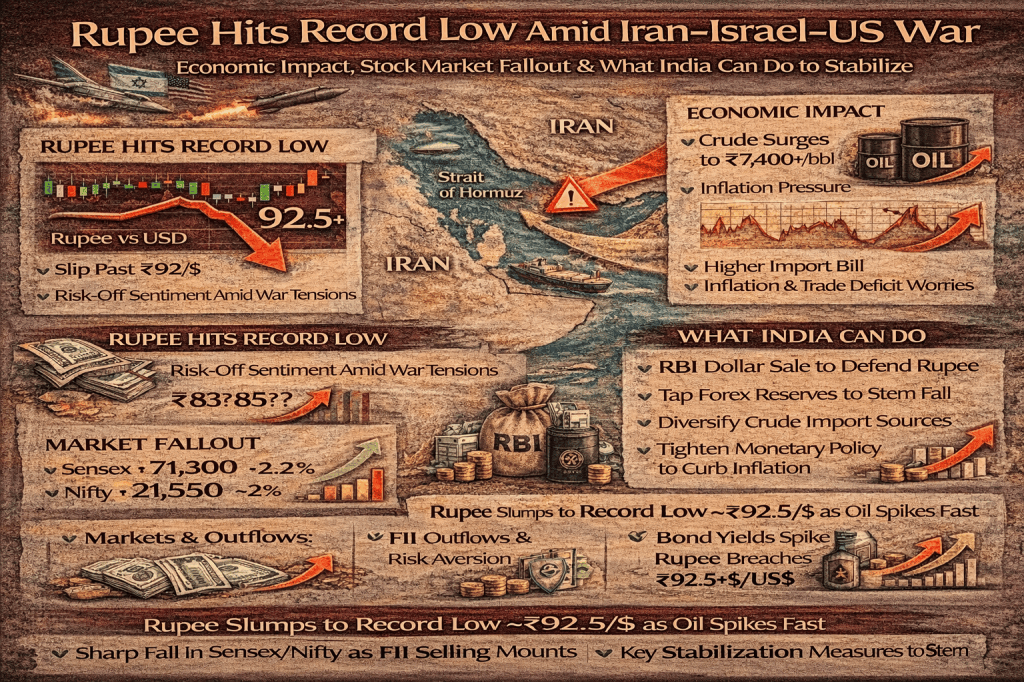
The Indian rupee has tumbled to a historic low of around ₹92+ against the US dollar, driven by escalating geopolitical tensions in the Middle East — particularly the ongoing conflict involving the United States, Israel and Iran — which has rattled global markets and pushed oil prices higher. (Reuters)
This sharp depreciation is not just a currency statistic — it has wide-ranging implications for India’s economy, inflation, corporate earnings, and investor sentiment. Below, we break down the key impacts and practical measures to address further depreciation.
📊 Why the Indian Rupee Is Sliding
Several factors are combining to weaken the rupee:
- Geopolitical risk & safe-haven demand: Global investors are flocking to the US dollar amid heightened war risks, squeezing emerging market currencies like the rupee. (Reuters)
- Rising crude oil prices: India imports over 80% of its crude oil needs — any surge in oil prices increases the demand for dollars to pay for imports. (ICICI Direct)
- Capital outflows: Foreign investors are selling Indian equities and bonds amid risk aversion, converting rupees to dollars and putting downward pressure on INR. (ICICI Direct)
- Stronger US dollar: A robust dollar makes emerging market currencies less attractive and increases the cost of servicing dollar-denominated debt. (Insights IAS)
🇮🇳 Impact on the Indian Economy
🔥 1. Inflationary Pressure (Imported Inflation)
A weaker rupee makes essential imports — especially crude oil — more expensive in rupee terms. This adds to cost-push inflation, pushing up petrol, diesel and logistics costs, which ripples through to food and consumer prices. (The Economic Times)
📉 2. Higher Import Bill & Trade Deficit
India’s trade deficit widens when imports become costlier relative to exports. A bigger trade gap exerts further pressure on foreign exchange reserves and the rupee. (La Excellence IAS Academy)
💼 3. Costlier External Debt Servicing
Corporations and the government that have borrowed in dollars face higher repayment costs, which can squeeze profits and public finances. (UPSC Aspirants)
📈 4. Potential Boost for Exporters (Silver Lining)
Certain export sectors like IT services, textiles, gems & jewellery may benefit as their products become cheaper in dollar terms — potentially boosting foreign demand. (IAS Express)
📉 5. Stock Market Volatility & Risk Aversion
The weakening rupee has already coincided with sharp falls in major Indian indices like the Sensex and Nifty, as investors move away from risk and reassess valuations. (Reuters)
📉 Impact on Stock Markets & Investors
- Foreign Portfolio Investors (FPIs) may continue withdrawing funds if uncertainty persists. This can amplify downward pressure on Indian equities.
- Industry sectors most vulnerable: oil & gas, airlines, automobile and consumer goods — especially those reliant on dollar-priced inputs.
- Safe-haven flows: Investors might shift allocations from Indian markets to US treasury bills or S&P 500 stocks, dampening demand for domestic risk assets. (Reuters)
🛡️ Measures to Prevent Further Depreciation
To stabilize the rupee, policymakers and market participants can consider:
🏦 1. Reserve Bank of India (RBI) Intervention
The RBI can use foreign exchange reserves to sell dollars and buy rupees — providing short-term support in FX markets. (Reuters)
🚀 2. Attracting Foreign Capital
Boosting Foreign Direct Investment (FDI) and encouraging long-term overseas capital can improve demand for INR and strengthen currency dynamics. (CMA Knowledge)
📦 3. Reducing Trade Deficit
- Diversifying energy sources (e.g., renewables, strategic crude deals) to reduce dependence on imported oil.
- Enhancing export competitiveness through better market access, logistics, and incentives. (Insights IAS)
📊 4. Structural Economic Reforms
Policies to enhance manufacturing, improve ease of doing business, and strengthen foreign investment frameworks can make India more resilient to global shocks. (CMA Knowledge)
💹 5. Monetary Policy Adjustments
Interest rate calibrations can help manage capital flows — balancing inflation control and external stability.
✍️ Conclusion
The rupee’s plunge to record lows is a reflection of broader global instability, rising oil prices, capital flow shifts, and safe-haven demand for the US dollar. While this presents challenges — especially inflationary pressure and market volatility — the effects are multifaceted.
With prudent policy action, targeted structural reforms, and strong foreign investment sentiment, India can manage these headwinds and potentially turn some challenges into long-term growth opportunities.
⚠️ Disclaimer
This post is for informational and educational purposes only and should not be considered financial or investment advice. Currency markets, stock markets, and economic conditions are subject to change; readers should perform their own research or consult with a professional before making financial decisions.


Leave a Reply