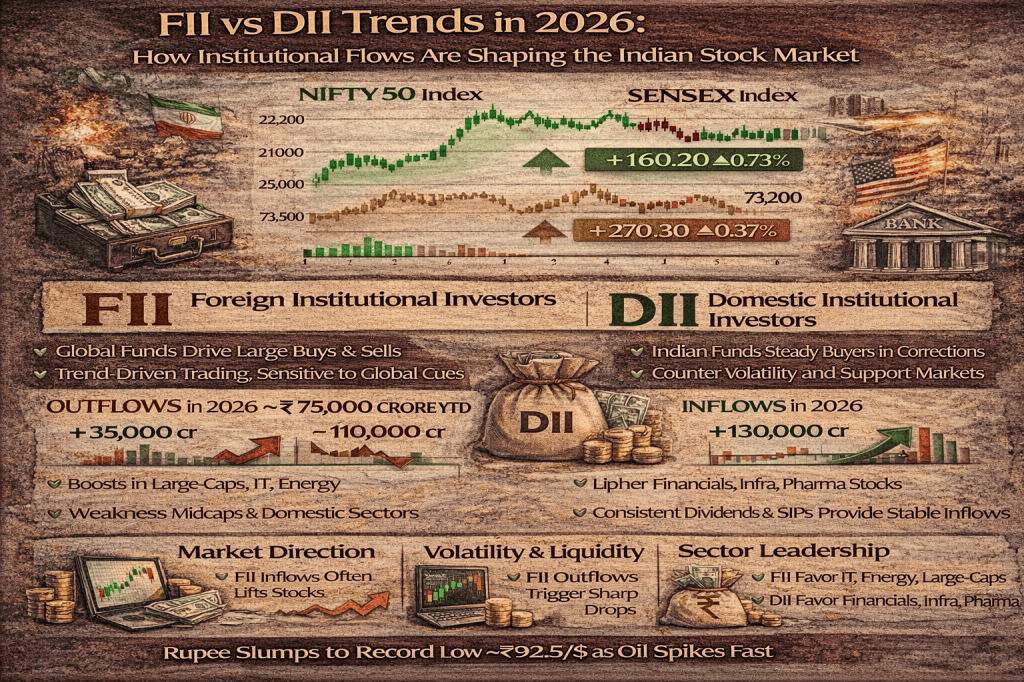
The Indian stock market in 2026 has been navigating a perfect storm of global and domestic uncertainties. From rising US tariffs and weak quarterly earnings to escalating geopolitical tensions in the Middle East due to the Iran–Israel–US conflict, investors have witnessed heightened volatility in equities.
In such an environment, one of the most closely watched indicators of market direction is the FII vs DII data trend. The ongoing tug-of-war between Foreign Institutional Investors (FIIs) and Domestic Institutional Investors (DIIs) is shaping market sentiment and liquidity in a significant way.
Let’s break down what the data trends reveal and what they mean for investors.
Understanding FIIs and DIIs
Before diving into the trends, it is important to understand the roles these two institutional forces play in the Indian market.
Foreign Institutional Investors (FIIs)
These include global investment funds, hedge funds, pension funds, and sovereign wealth funds investing in Indian equities. Their investment decisions are largely influenced by global factors such as US interest rates, currency movements, geopolitical tensions, and global risk appetite.
Domestic Institutional Investors (DIIs)
DIIs consist of Indian mutual funds, insurance companies, pension funds, and financial institutions. Their investments are primarily driven by domestic savings flows, especially through Systematic Investment Plans (SIPs) and long-term retirement funds.
Over the last decade, DIIs have emerged as a powerful stabilizing force in Indian markets.
The Structural Shift: Domestic Money is Rising
One of the biggest structural changes in Indian markets has been the rise of domestic capital.
For the first time in history, DIIs surpassed FIIs in ownership of NSE-listed companies, marking a major shift in market structure. DIIs held around 17.62% of the market compared with FIIs at 17.22%, highlighting the growing influence of domestic capital. (Business Standard)
This transformation has been driven by:
- Record SIP inflows from retail investors
- Growing mutual fund penetration
- Increasing participation from pension and insurance funds
- Financialization of household savings
As a result, the Indian market today is far less dependent on foreign money than it was a decade ago.
FII Behaviour in 2026: Highly Sensitive to Global Events
Foreign investors have shown cautious behavior in 2026 due to a series of global macro triggers.
Key Factors Driving FII Outflows
1. Geopolitical Tensions in the Middle East
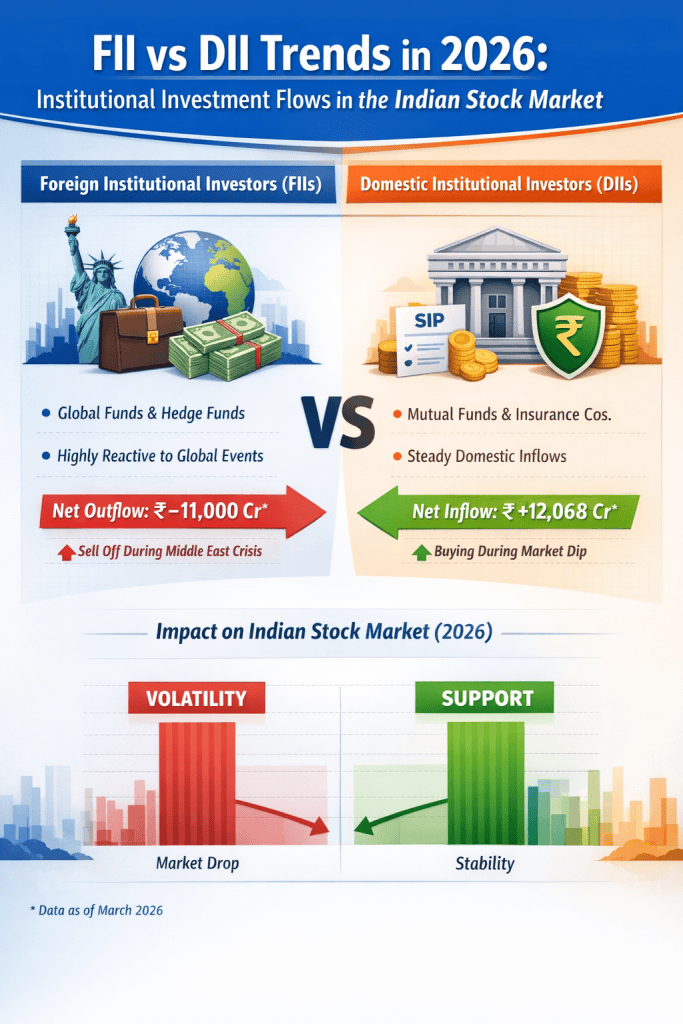
Escalation of the Iran–Israel–US conflict has created risk aversion in global markets. FIIs sold nearly ₹11,000 crore worth of Indian equities within two trading sessions during the conflict escalation, highlighting how quickly global funds can exit emerging markets during uncertainty. (The Economic Times)
At the same time, oil prices surged and the Indian rupee weakened to record levels amid the crisis, further increasing risk perception among global investors. (Reuters)
2. Global Trade and Tariff Uncertainty
US tariff policies and trade negotiations have also impacted global capital flows. When trade tensions rise, global funds often reduce exposure to emerging markets, including India.
3. Valuation Concerns
Indian equities continue to trade at premium valuations compared to other emerging markets, prompting FIIs to rotate funds to cheaper markets.
DII Behaviour in 2026: The Market Stabilizer
While FIIs react to global developments, DIIs have played the role of a shock absorber.
For example, on 4 March 2026, the data showed:
- FII Net Selling: ₹8,752 crore
- DII Net Buying: ₹12,068 crore
This indicates that domestic institutions were strong buyers despite foreign selling pressure. (Swastika Investmart)
Such trends have become common in recent years.
Domestic investors—especially mutual funds—continue to deploy large amounts of capital due to steady SIP inflows and long-term investment strategies.
2026 Market Volatility: Why the FII–DII Battle Matters
The current market volatility is largely a reflection of this institutional tug-of-war.
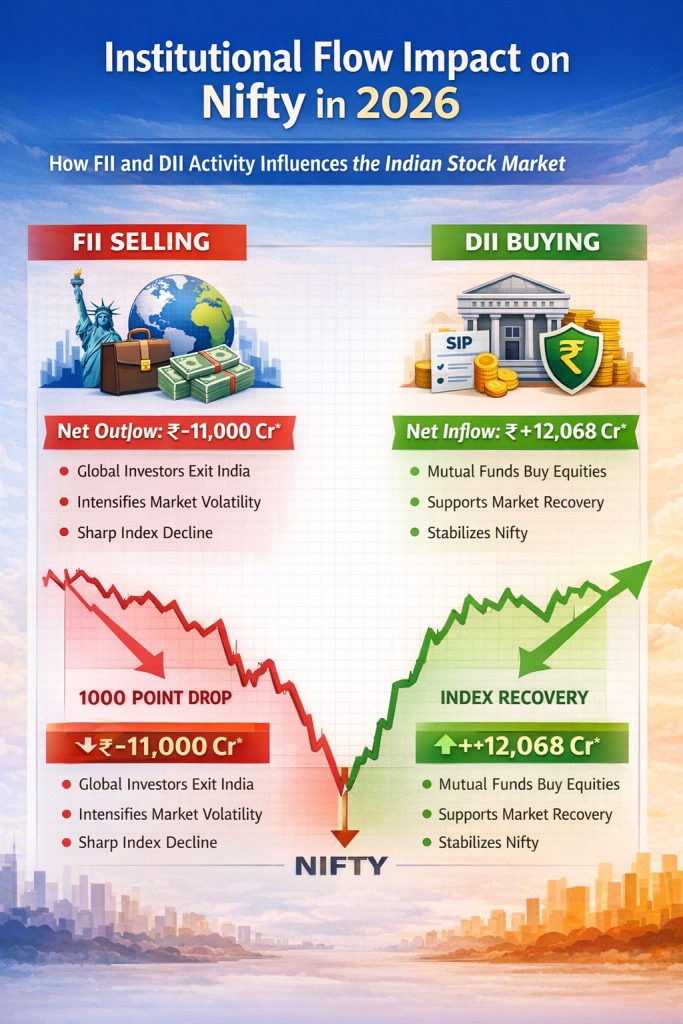
When FIIs Sell
Markets often witness sharp intraday corrections because FIIs hold large positions in heavyweight stocks like banks, IT companies, and large-cap industrials.
When DIIs Buy
Domestic institutions cushion the fall by absorbing selling pressure and providing liquidity.
This dynamic prevents the kind of deep crashes that used to occur in earlier decades when markets were heavily dependent on foreign capital.
What the Trend Signals for the Indian Market
1. Indian Markets Are Becoming More Resilient
The rising share of domestic capital is reducing the market’s vulnerability to global capital flight.
2. FIIs Still Drive Short-Term Momentum
Despite the structural shift, FIIs still influence market direction because of their concentrated holdings in large-cap stocks.
3. DIIs Provide Long-Term Stability
The steady inflows from SIPs and retirement funds provide consistent liquidity even during global crises.
What Should Investors Watch Now?
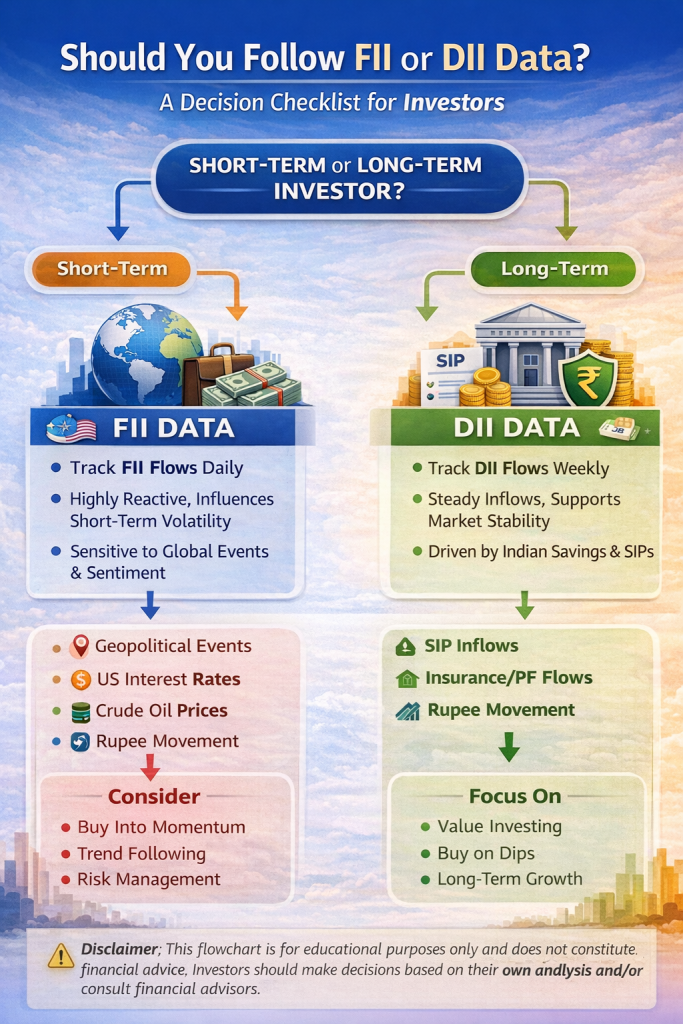
Investors should keep an eye on the following indicators:
1. Daily FII–DII Data
This gives clues about short-term market sentiment.
2. Crude Oil Prices
India is a major oil importer, and rising crude prices affect inflation and currency stability.
3. Rupee Movement
Currency depreciation often triggers FII selling.
4. Global Interest Rates
Higher US yields usually attract global capital away from emerging markets.
Final Thoughts
The FII vs DII dynamics in 2026 highlight a significant transformation in the Indian equity market.
While foreign investors continue to influence short-term volatility, the rise of domestic institutional capital has fundamentally strengthened market resilience.
In the coming years, the balance between global capital flows and domestic savings will play a crucial role in shaping the trajectory of Indian equities.
For long-term investors, this shift toward a domestically supported market structure is a positive development that could make Indian markets more stable and less vulnerable to external shocks.
Disclaimer
This article is for informational and educational purposes only and should not be considered financial or investment advice. Stock market investments are subject to market risks, including volatility arising from geopolitical developments, economic changes, and policy decisions. Investors should conduct their own research or consult a qualified financial advisor before making any investment decisions.


Leave a Reply