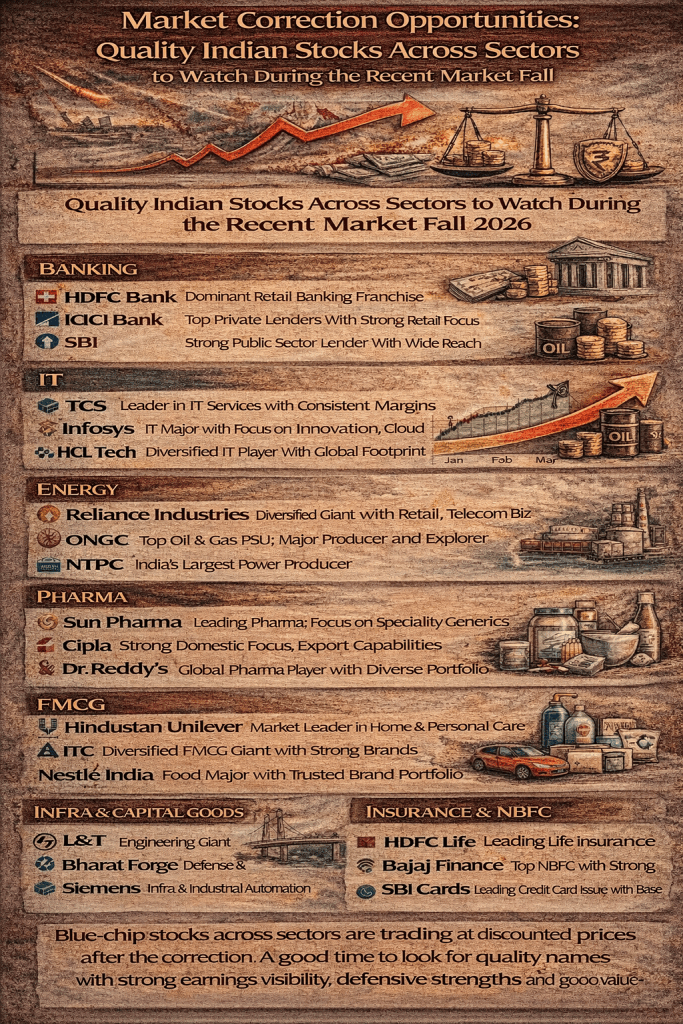
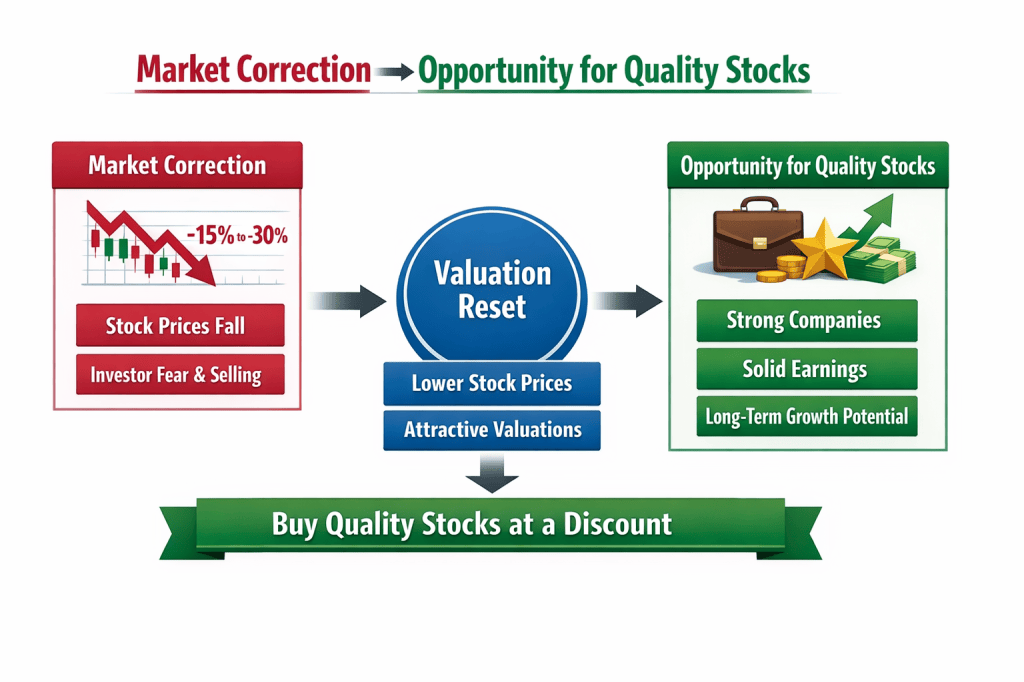
Stock market corrections often create panic among investors. However, history shows that temporary market declines sometimes open opportunities to study fundamentally strong companies at relatively attractive valuations.
In the recent fall in the Indian stock market, the correction has been more severe in mid-cap and small-cap stocks, while many large-cap companies have also experienced moderate declines. (moneycontrol.com)
For long-term investors, such phases are often useful to revisit quality businesses with strong fundamentals, consistent earnings growth, and long-term sectoral tailwinds.
This article highlights a few well-known fundamentally strong companies across sectors and market capitalisations. The aim is to understand their business strength, future opportunities, and sector outlook — purely from an educational perspective.
1. Banking Sector
HDFC Bank
One of India’s most consistent private sector banks, HDFC Bank has built a strong reputation for prudent lending and asset quality.
Key Fundamentals
- Industry-leading asset quality
- Strong retail loan portfolio
- Consistent profitability and high return on equity
- Wide distribution network and strong digital banking presence
The bank has historically maintained strong balance sheet quality and stable earnings growth, making it a classic long-term compounder in the Indian financial sector. (5paisa.com)
Future Opportunities
- Growing retail credit demand in India
- Cross-selling opportunities after the HDFC merger
- Digital banking expansion
As India’s credit penetration continues to grow, private sector banks like HDFC Bank are expected to remain major beneficiaries.
ICICI Bank
Another major private sector bank that has undergone a strong transformation over the last decade is ICICI Bank.
Key Fundamentals
- Improved asset quality after NPA clean-up
- Balanced loan book across retail and corporate segments
- Strong capital adequacy
- Technology-driven banking services
ICICI Bank has significantly strengthened its balance sheet and improved profitability metrics in recent years. (5paisa)
Growth Drivers
- Retail lending expansion
- Digital banking adoption
- Corporate credit growth with economic expansion
2. Information Technology Sector
Tata Consultancy Services (TCS)
TCS is one of India’s largest IT services companies and a global leader in outsourcing and digital transformation.
Key Fundamentals
- Debt-free balance sheet
- High operating margins above 20%
- Strong free cash flow generation
- Global client base across industries
The company benefits from long-term technology spending trends including cloud computing, AI, and digital transformation services. (equentis.com)
Future Opportunities
- AI-driven enterprise solutions
- Large digital transformation deals
- Global IT outsourcing demand
Despite cyclical slowdowns in IT spending, companies like TCS remain structurally strong due to their scale and client relationships.
Infosys
Another major IT services company with strong governance and consistent performance is Infosys.
Strengths
- Global enterprise client base
- Leadership in digital services and automation
- Strong corporate governance reputation
Infosys continues to benefit from global technology adoption trends, particularly in cloud migration and AI-driven software services.
3. Infrastructure & Engineering Sector
Larsen & Toubro (L&T)
India’s infrastructure development push makes Larsen & Toubro one of the most strategically positioned companies.
Business Strength
- Diversified engineering and construction portfolio
- Large order book across domestic and international projects
- Strong presence in defense and infrastructure
Future Opportunities
- Government infrastructure spending
- Defense manufacturing expansion
- Energy transition projects
India’s long-term infrastructure build-out provides structural growth opportunities for engineering giants like L&T.
4. Consumer Sector
Hindustan Unilever (HUL)
In the consumer goods segment, Hindustan Unilever is often considered a defensive business due to its strong brand portfolio.
Key Strengths
- Powerful brands across personal and home care products
- Extensive distribution network across India
- Consistent revenue growth and profitability
Its strong brand presence and pricing power have allowed the company to maintain steady performance even during economic slowdowns. (geosquare.in)
Long-Term Drivers
- Rising rural consumption
- Premium product categories
- Expanding FMCG market in India
5. Telecom Sector
Bharti Airtel
India’s telecom industry has consolidated significantly over the last decade, leaving a few dominant players.
Bharti Airtel has emerged as one of the strongest telecom companies in the country.
Business Strengths
- Large subscriber base
- Growing ARPU (Average Revenue Per User)
- Leadership in 4G and 5G services
Future Growth Drivers
- Rapid growth in data consumption
- Expansion of 5G infrastructure
- Enterprise and digital services
Telecom services are increasingly becoming a critical part of India’s digital economy.
6. Pharmaceutical Sector
Sun Pharmaceutical Industries
The pharmaceutical sector often acts as a defensive space during market volatility.
Sun Pharma is the largest pharmaceutical company in India with a strong global presence.
Key Strengths
- Specialty drug portfolio
- Global generics market presence
- Strong R&D capabilities
Future Opportunities
- Specialty medicines
- US generics market expansion
- Increasing global healthcare demand
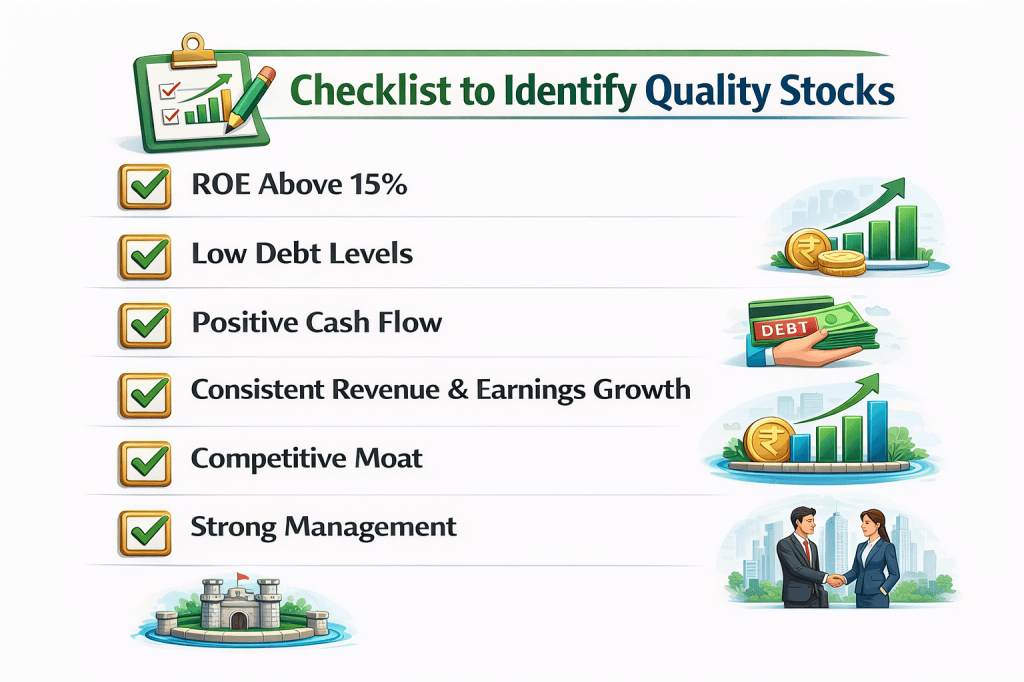
What Defines a “Quality Stock”?
Investors often evaluate quality businesses using several financial indicators:
- Consistent Return on Equity (ROE)
- Strong cash flows and margins
- Low debt levels
- Stable earnings growth
Companies that maintain high margins, healthy ROE, and strong balance sheets tend to demonstrate durable business models over long periods. (smartinvestingindia.com)
Final Thoughts
Market corrections can be uncomfortable for investors, but they also remind us of an important investing principle:
Strong businesses often survive market cycles and continue compounding over long periods.
Instead of reacting emotionally to short-term volatility, investors often benefit from studying the fundamentals of companies, sector trends, and long-term growth drivers.
The companies discussed above represent some of the well-established businesses in their respective sectors, and studying their fundamentals during market corrections can provide valuable insights for investors.
Disclaimer
This article is intended purely for educational and informational purposes. The companies mentioned are used as examples to discuss business fundamentals and sectoral trends. This content does not constitute investment advice, stock recommendations, or a solicitation to buy or sell any securities. Investors should conduct their own research or consult a qualified financial advisor before making investment decisions. Investments in the stock market are subject to market risks.


Leave a Reply