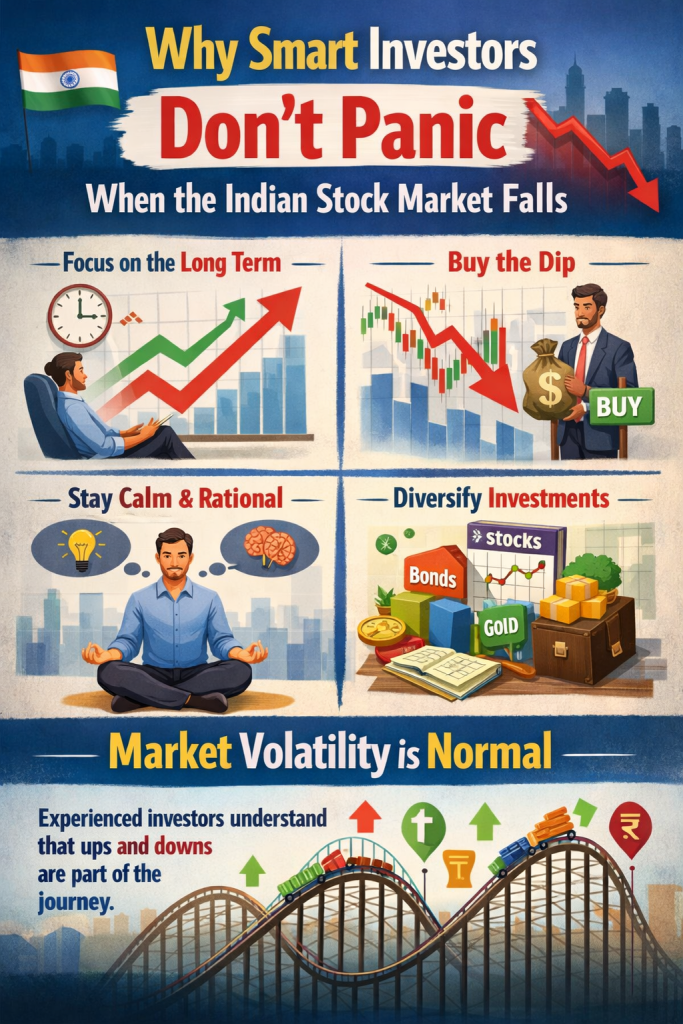
Stock market volatility often creates anxiety among investors. When indices like the Nifty 50 or BSE Sensex experience sudden declines, many retail investors panic and rush to sell their holdings.
However, experienced investors often react very differently.
Instead of seeing market corrections as disasters, they view them as a natural part of the investing cycle.
Market Corrections Are Normal
Stock markets rarely move in a straight line. Periods of growth are often followed by corrections due to factors such as:
- global economic uncertainty
- geopolitical developments
- changes in interest rates
- institutional investor activity.
These corrections help reset valuations and bring balance to the markets.
Experienced Investors Focus on the Long Term
One key difference between retail investors and experienced investors is time horizon.
Short-term traders may react quickly to daily market movements, but long-term investors often focus on:
- business fundamentals
- earnings growth
- industry potential
- economic trends.
This long-term perspective helps them avoid emotional decisions during temporary market volatility.
Understanding Market Fear Indicators
Sometimes market fear becomes visible through indicators such as India VIX, which measures expected market volatility.
When volatility increases, markets may experience sharp swings. However, seasoned investors understand that volatility is part of the market ecosystem.
Corrections Can Also Create Opportunities
Market declines sometimes allow investors to evaluate fundamentally strong companies at more reasonable valuations.
Companies with strong balance sheets, stable earnings, and strong market positions often remain resilient even during uncertain times.
These businesses may continue to grow over the long term despite short-term market fluctuations.
The Importance of Diversification
Another strategy experienced investors follow is diversification.
A balanced portfolio may include a mix of:
- equities
- bonds
- assets like Gold
This helps reduce overall portfolio risk during periods of market volatility.
The Bigger Lesson
Market volatility can feel uncomfortable, but history shows that markets have repeatedly recovered from periods of uncertainty.
Investors who remain disciplined and focus on long-term fundamentals often navigate these phases more effectively than those who react emotionally.
Understanding how markets behave during corrections can help investors develop a more balanced and resilient investment approach.
Disclaimer
This article is for educational and informational purposes only and should not be considered financial or investment advice. Investments in stocks and commodities are subject to market risks. Investors should conduct their own research or consult a qualified financial advisor before making investment decisions.


Leave a Reply