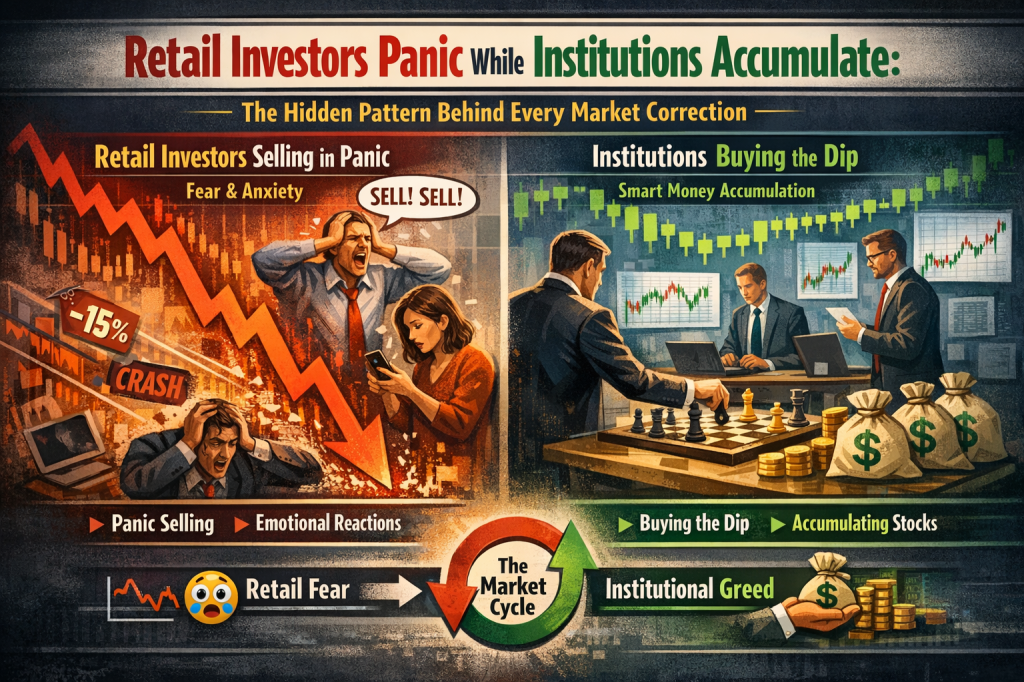
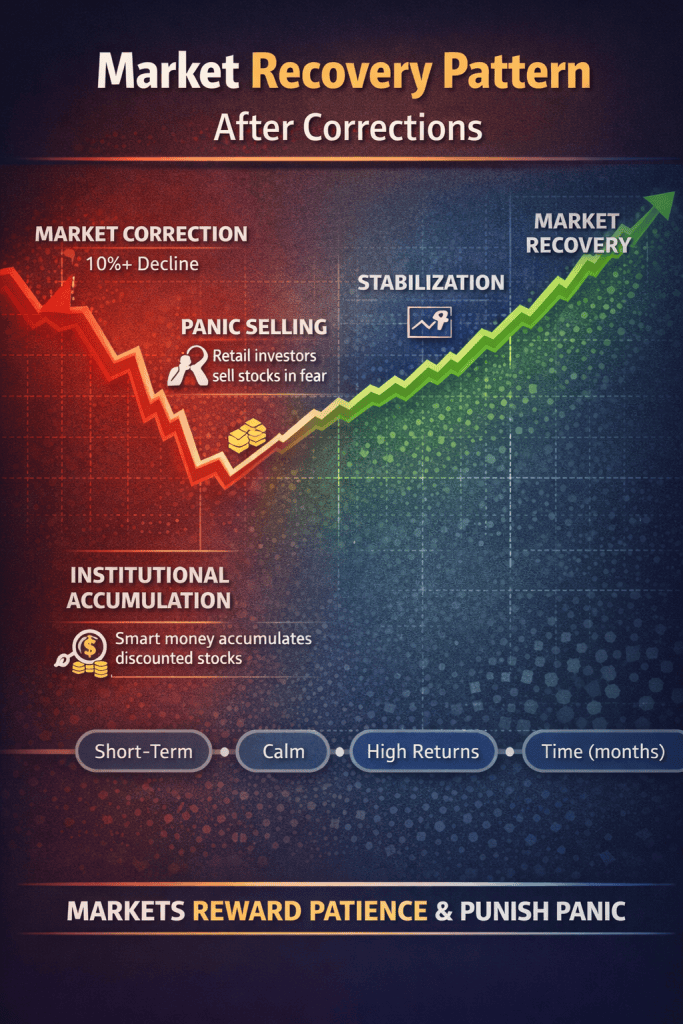
Market corrections are a natural part of the stock market cycle. Yet every time markets fall sharply, the reaction pattern of different participants often remains the same: retail investors panic and sell, while institutional investors quietly accumulate quality assets at lower prices.
This behavioral pattern has repeated itself across global markets and across decades. Understanding this cycle can help investors make better long-term decisions rather than reacting emotionally during volatility.
Understanding Market Corrections
A market correction typically refers to a decline of around 10% or more from recent highs in a stock index or a group of stocks. Corrections can be triggered by multiple factors such as:
- Geopolitical tensions
- Inflation concerns
- Interest rate changes
- Global economic uncertainty
- Temporary profit booking
While corrections can feel alarming in the short term, they are often healthy for markets as they remove excessive speculation and bring valuations closer to fundamentals.
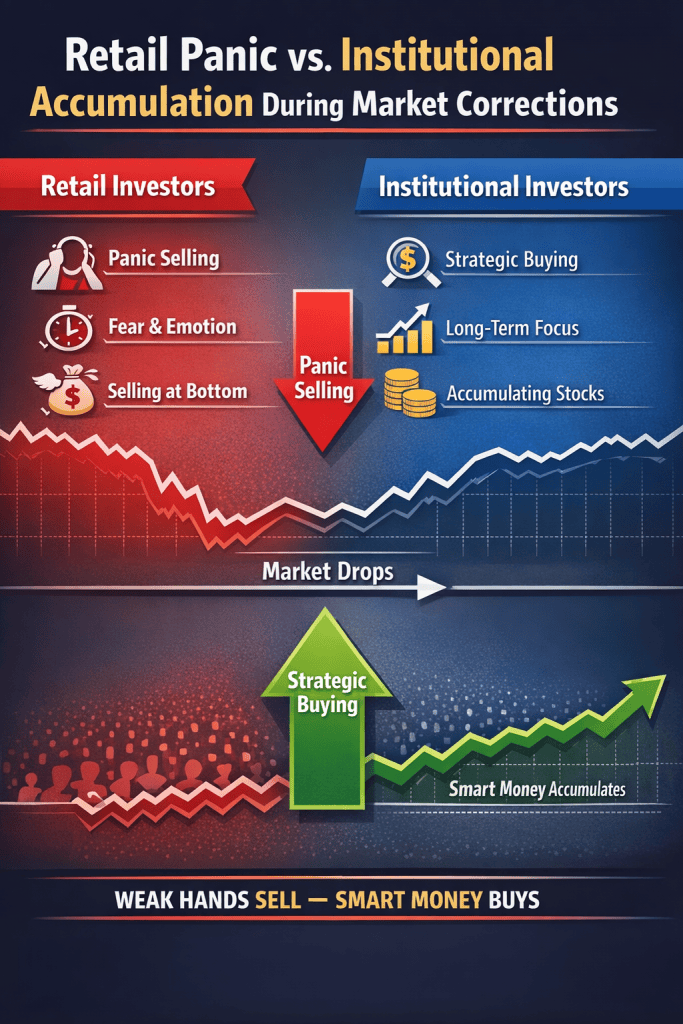
The Retail Investor Reaction: Fear and Panic Selling
Retail investors tend to react emotionally during market declines. When prices start falling rapidly, fear often replaces rational thinking.
Common retail investor reactions include:
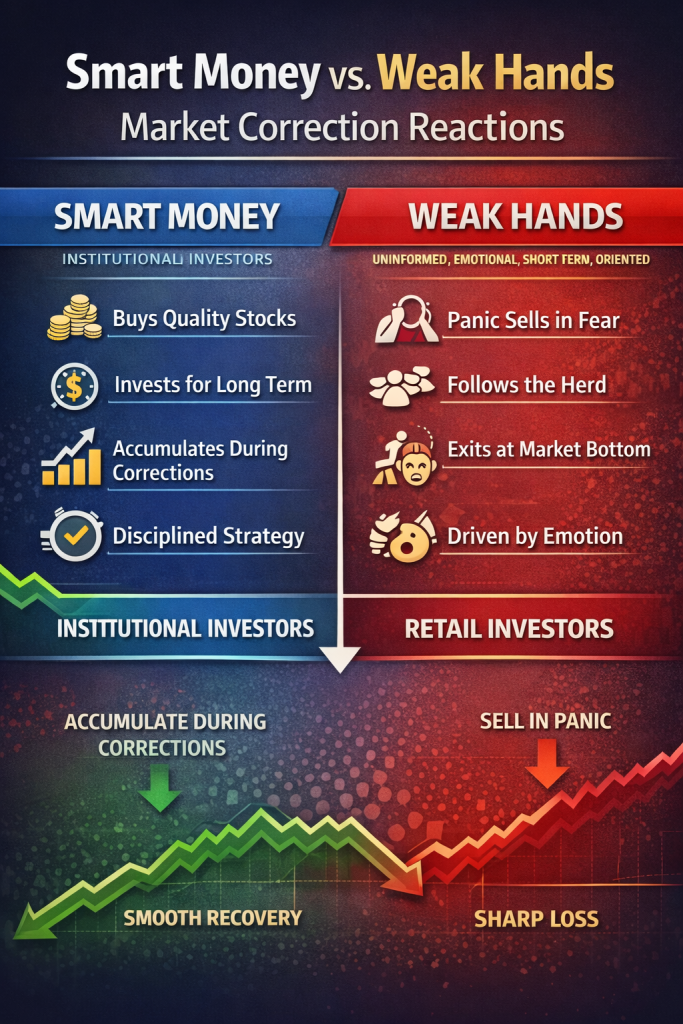
- Panic selling to avoid further losses
- Exiting long-term investments prematurely
- Trying to time the exact bottom
- Moving money into “safe” assets after the fall already happened
This behavior is driven by loss aversion and herd mentality. When investors see markets falling and negative news dominating headlines, many feel compelled to sell simply because others are selling.
Unfortunately, this often results in selling near market bottoms.
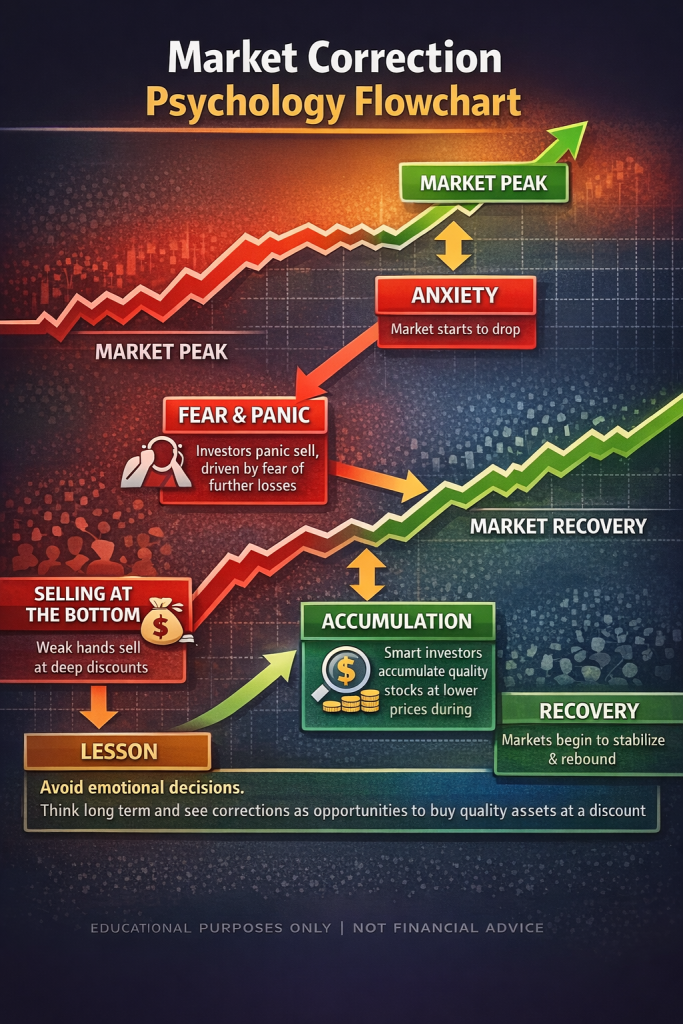
Institutional Investors: Buying When Others Fear
Institutional investors—such as mutual funds, pension funds, insurance companies, and large investment firms—typically take a more strategic approach.
During market corrections, institutions often:
- Accumulate fundamentally strong stocks at discounted valuations
- Increase exposure to sectors with long-term growth potential
- Deploy cash reserves gradually
- Focus on valuation and fundamentals rather than short-term sentiment
Because of their long-term investment horizon and research capabilities, institutional investors often view corrections as opportunities rather than threats.
Historical Pattern: Panic Followed by Recovery
Market history repeatedly demonstrates this behavioral pattern.
Examples include:
- Global Financial Crisis
Markets collapsed worldwide, triggering massive retail selling. However, institutions accumulated quality stocks that later delivered significant long-term returns. - COVID‑19 Market Crash
The sharp market fall in early 2020 saw heavy retail panic selling, while institutional investors steadily increased exposure to technology, pharmaceuticals, and digital economy companies. - Russia–Ukraine War Market Volatility
Initial panic led to short-term volatility, but markets eventually stabilized as institutional capital returned.
These episodes show that markets often recover once uncertainty stabilizes, rewarding investors who remain patient.
Why This Pattern Repeats
Several structural reasons explain why institutions tend to accumulate during corrections:
1. Better Research and Data
Institutional investors rely on extensive research teams, macroeconomic models, and valuation frameworks.
2. Long-Term Capital
Many institutions manage funds with long investment horizons, allowing them to tolerate short-term volatility.
3. Access to Liquidity
Institutions often keep cash reserves specifically to deploy during market declines.
4. Discipline Over Emotion
Professional fund management typically follows predefined strategies rather than emotional reactions.
What Retail Investors Can Learn
Retail investors can benefit by observing how institutional money behaves during corrections.
Some practical lessons include:
- Avoid making decisions purely based on fear or headlines
- Focus on fundamentally strong companies
- Maintain a long-term investment horizon
- Use corrections to gradually accumulate quality stocks
- Diversify across sectors and asset classes
Rather than trying to perfectly time market bottoms, disciplined investing and patience tend to produce better long-term outcomes.
The Bigger Picture
Market corrections are not unusual—they are an integral part of market cycles. While they create short-term discomfort, they also present opportunities for long-term investors.
History repeatedly shows that markets reward patience and punish panic.
By understanding the behavioral differences between retail investors and institutional investors, individuals can avoid emotional decisions and adopt a more strategic approach to investing.
Disclaimer
This article is for educational and informational purposes only and should not be considered financial or investment advice. Stock market investments are subject to market risks, and past patterns or historical examples do not guarantee future performance. Investors should conduct their own research or consult a qualified financial advisor before making any investment decisions.


Leave a Reply