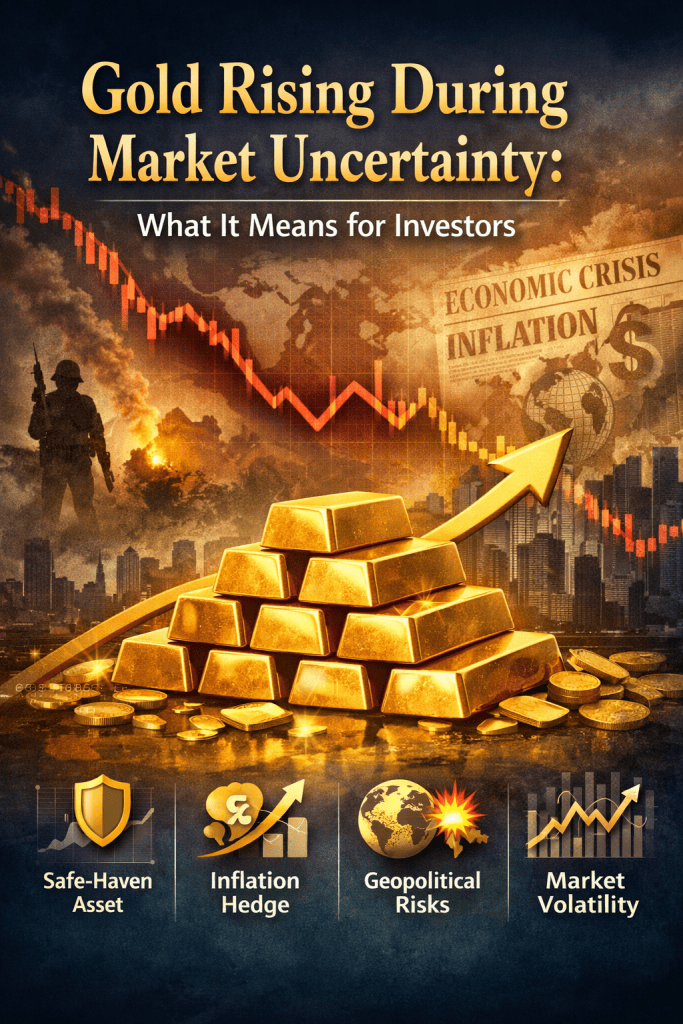
Whenever financial markets experience uncertainty, one asset often grabs investors’ attention — gold. Throughout history, gold has been viewed as a safe-haven asset, meaning investors tend to move their money into it when risk in other markets rises.
During periods of geopolitical tension, economic slowdown, inflation worries, or stock market volatility, gold prices often move upward. Understanding why this happens can help investors interpret market signals more clearly.
Gold as a Safe-Haven Asset
Gold has long been considered a store of value. Unlike stocks or currencies, it is not tied directly to the performance of a company or the policy decisions of a government.
During times of uncertainty such as wars, financial crises, or sharp market corrections, investors often shift funds from riskier assets into gold. This phenomenon has been visible during events like the 2008 Global Financial Crisis and the market panic triggered by the COVID-19 Market Crash of 2020.
In such situations, gold acts as a financial hedge against uncertainty and market instability.
Why Gold Prices Rise During Market Volatility
Several factors drive the rise in gold prices when markets become uncertain:
1. Investor Risk Aversion
When stock markets experience sharp declines, investors often become risk-averse. Instead of holding volatile equities, they prefer assets perceived as safer. Gold typically becomes a preferred destination during such times.
2. Weakening Currency and Inflation Concerns
Gold is often viewed as a hedge against currency depreciation and inflation. When central banks increase liquidity or when currencies weaken, gold tends to gain value.
In countries like India, gold is not only an investment asset but also a cultural store of wealth, which further increases demand during uncertain periods.
3. Geopolitical Tensions
Global tensions often trigger a flight to safety. For example, geopolitical conflicts in regions such as the Middle East or events like the Russia–Ukraine War have historically caused spikes in gold prices due to rising global uncertainty.
4. Institutional and Central Bank Buying
Large institutional investors and central banks also increase gold holdings during uncertain periods. Central banks use gold reserves to diversify their holdings away from fiat currencies.
In recent years, several emerging economies have increased their gold reserves to strengthen financial stability.
What Rising Gold Prices Signal for Investors
A rising gold price does not necessarily mean stock markets will continue to fall. Instead, it often signals that investor sentiment is shifting toward caution.
Some key interpretations include:
- Increased market uncertainty
- Rising geopolitical risks
- Investors hedging against inflation
- Portfolio diversification by institutions
Gold’s movement can therefore act as a sentiment indicator for global financial markets.
Should Investors Shift Completely to Gold?
While gold provides stability during uncertain times, it is generally not considered a high-growth asset compared to equities.
Most financial experts suggest maintaining a balanced portfolio, where gold plays a role as a diversification tool rather than a primary growth investment.
A diversified allocation might include equities, bonds, and a small portion of gold to manage risk during volatile market phases.
Final Thoughts
Gold’s rise during periods of market uncertainty reflects changing investor sentiment and risk perception. While it often benefits from global instability, its primary role in a portfolio is wealth preservation and risk hedging.
For investors, observing gold price trends can provide valuable insights into broader market psychology and potential shifts in global financial conditions.
Disclaimer
This article is for educational and informational purposes only and should not be considered financial or investment advice. Market conditions change frequently, and investors should conduct their own research or consult a qualified financial advisor before making investment decisions.


Leave a Reply